


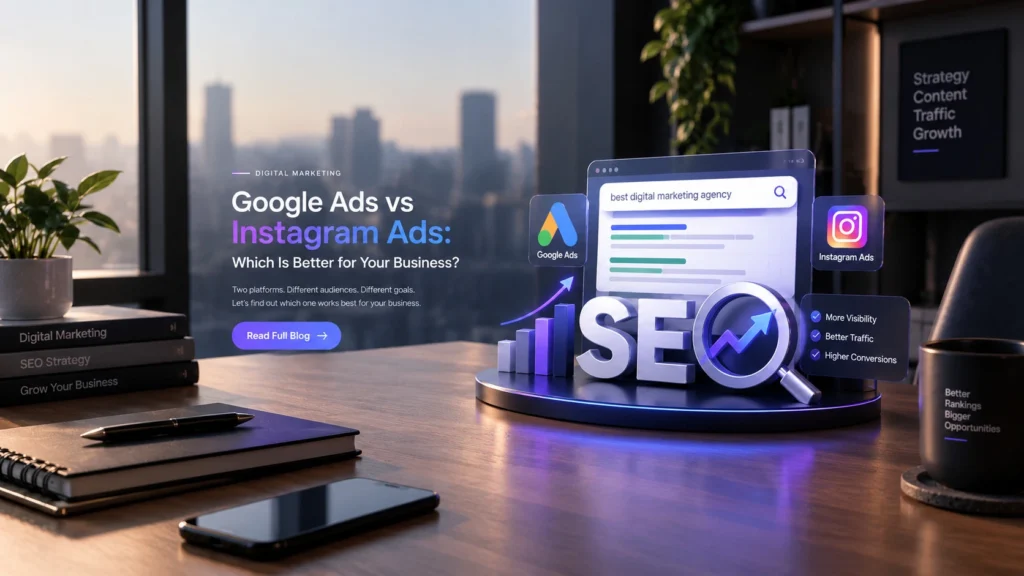
Imagine you own a business and have ₹10,000 set aside for digital marketing. You want more customers, but you’re unsure where to spend that money. Should you run Google Ads, where people search for products and services, or Instagram Ads, where people discover brands while scrolling?
It’s a question many business owners face, especially when they’re starting to market their business online.
The truth is, neither platform is automatically better. The right choice depends on what you sell, who your customers are and how they usually make buying decisions. Before spending your budget, it’s worth understanding how the two platforms work and what each can realistically help you achieve.
1. Understand the difference between searching and discovering
The biggest difference comes down to why people see your advertisement.
On Google, someone might search for “website developer in Kolhapur” because they already need a website and are looking for someone to build it. Your advertisement can reach them while they’re actively looking for a relevant service.
On Instagram, someone might come across a video showing a beautifully designed website, an interesting product or a business transformation. They weren’t necessarily looking for that service, but the content might spark their interest.
Both situations can lead to customers, but the starting point is different.
Google Ads can be particularly useful when people actively search for what you offer. Instagram Ads can help introduce your business to relevant audiences, demonstrate your products and create interest.
The important question isn’t which platform is more popular. It’s where your potential customers are most likely to take the next step.
2. Which platform suits your type of business?
Let’s look at a few realistic examples.
A service-based business: Suppose you run a plumbing company. Someone searching for an emergency plumber may be ready to contact a provider immediately. Google Search Ads could help you reach people looking for that service, provided your targeting and advertising are set up appropriately.
A clothing brand: If you sell visually appealing clothing, Instagram can be useful for showcasing styles, styling ideas and new collections. Strong photographs and short videos can help potential customers understand the products before visiting your store.
A web development company: A business owner searching for a website developer may already have a specific requirement. Google Search Ads could help capture that demand. Instagram content, meanwhile, could show website redesigns, explain common mistakes and introduce your services to business owners who haven’t started searching yet.
These are examples, not guarantees. Results depend on factors such as competition, the quality of your offer, audience targeting, pricing and the customer journey.
3. Don’t choose a platform before understanding your customer
Before launching any campaign, take a step back and think about how your customers usually buy.
Do they compare several providers before making contact? Do they discover new products through social media? Are they looking for an urgent service, or do they take weeks to decide?
A person searching for a nearby repair service may behave differently from someone considering a new clothing brand. Treating both audiences in exactly the same way can waste advertising budget.
Look at your existing customers, ask how they found your business and check which enquiries are most valuable. Even a few useful conversations can reveal more than choosing a platform simply because another business is using it.
4. Your advertisement is only part of the journey
Here’s something business owners sometimes overlook: getting someone to click an advertisement is not the same as getting them to become a customer.
Imagine your Instagram advertisement shows an attractive product, but clicking it takes people to a slow website where the product is difficult to find. Or your Google advertisement promises a specific service, but the landing page doesn’t explain what’s included.
The advertisement may be doing its job, but the next step is letting the customer down.
Before launching a campaign, check that the destination page matches the advertisement. Product information, service details, contact options and the next action should be easy to understand.
Your website development page can explain how a well-planned website supports the customer journey. (Suggested URL; verify it against your actual website.)
5. Start with a budget you can learn from
You don’t need to advertise on every platform at once.
If your budget is limited, choose the platform that best matches your immediate objective. Set a clear testing period, decide what you want to measure and make sure the budget is affordable for your business.
For instance, a business receiving regular enquiries from Google searches might test a focused search campaign. A new product brand with good visual content might begin by testing Instagram creatives with a relevant audience.
Avoid dividing your budget equally between platforms simply for the sake of balance. Equally, don’t judge a campaign after just a handful of clicks without considering the sales cycle and the amount of data collected.
Your first campaign should help you learn which audience, message and offer attract the most relevant response.
6. Measure what happens after the click
Clicks and impressions can show whether people are seeing and interacting with your advertisements, but they don’t tell the whole story.
Depending on your business, useful measurements might include enquiries, qualified leads, purchases and the cost of acquiring a customer.
A campaign that produces many inexpensive clicks but no relevant enquiries may be less valuable than one that generates fewer, more suitable prospects.
This is where performance marketing becomes relevant: campaigns should be evaluated against meaningful business objectives, with appropriate tracking in place.
Make sure the tracking works before spending heavily. Also consider the quality of the leads, the value of sales and the time it takes for someone to become a customer. Those details help you make better decisions than clicks alone.
So, Google Ads or Instagram Ads?
Start with the platform that aligns most closely with how your customers discover and choose your products or services.
Google Ads may be a sensible starting point when people are actively searching for your offer. Instagram Ads may suit businesses that benefit from visual storytelling, product discovery and building interest. Some businesses may eventually benefit from both, with each platform playing a different role.
You don’t need to guess perfectly from the beginning. Define your goal, start with a focused campaign, measure the results and use what you learn to improve the next one.
Planning digital marketing for your business?
Visit Dexter HiTech to discuss your business goals and digital marketing requirements with our team.